
EN
Follow us on
EMEAT is launching a series of in-depth industry reports, which we have named Insights Briefs. The inaugural edition focuses on Processing Beef. Here is a section of the report that provides a detailed historical perspective on how we reached the point where 80% lean trimming prices are approaching $4.00 per pound.
This preview highlights just a portion of the analysis available in the full report. The complete Insights Brief provides deeper market context, expanded historical trends, and actionable insights to support informed decision-making.
The full report will be available soon as part of EMEAT's growing portfolio of market intelligence products. We hope you enjoy this preview and invite you to check back soon for access to the complete report.
Start exploring today and gain access to market prices, historical data, forecasts, trade statistics, and industry insights in one place.
Where does our processing beef come from?
Domestic Production and Sales
For domestic products, sales of processing beef fall under the USDA “Ungraded” category.
While the USDA includes various cuts under this category, ungraded cattle represent less than 10% of total slaughtered cattle.
Therefore, it is safe to assume that most sales reported by the USDA as "Ungraded" consist of grind and trim (i.e., processing beef).
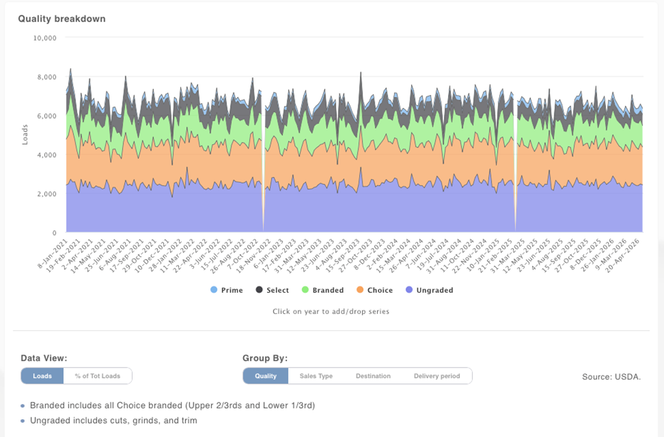
Sales of ungraded beef in the U.S. have remained fairly steady at approximately 2,500 loads per week, or 430 million pounds per month, as shown in Chart 1 below.
Where does our processing beef come from?
Imported Processing Beef
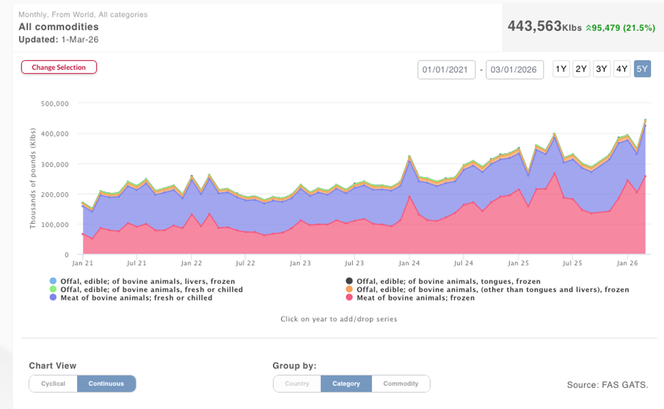
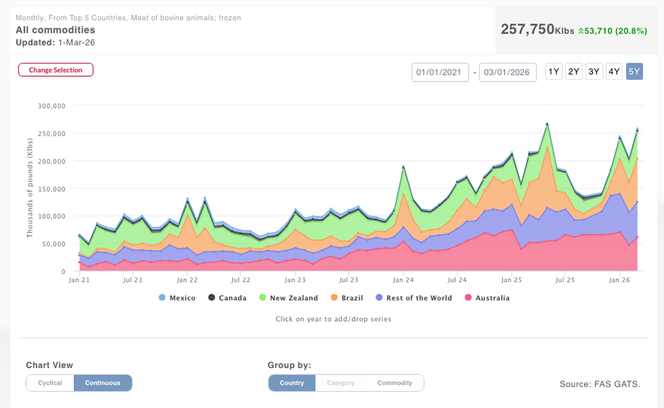
Assuming that the vast majority of imported frozen beef is for processing, we can use import data from the FAS GATS database to estimate imports of processing beef.
Charts 2 and 3 show that imports more than doubled between the beginning of 2023 and March 2026, rising from 100 million pounds to over 250 million pounds.
Since the U.S. is not an exporter of processing beef, we can conclude that monthly U.S. consumption averages approximately 600 million pounds, with imports representing about one-third of that total.
Long-term perspective: How we got here
Chart 4 illustrates the steady decline in cattle slaughter, dropping from over 600,000 head per week in 2023 to an average of 520,000 over the past few weeks.
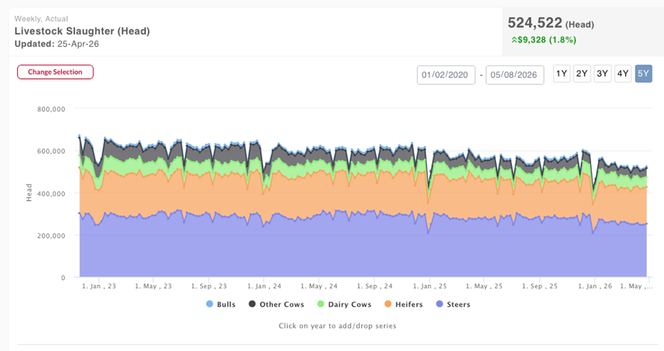
This reduction follows the extensive heifer and cow liquidations triggered by the 2020–2024 droughts (Charts 5 & 6).
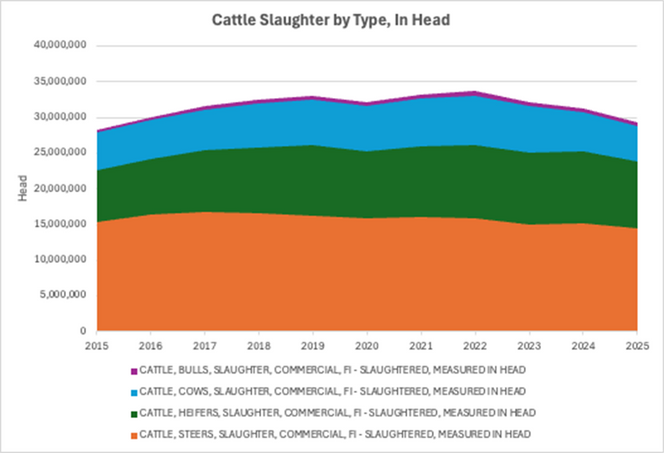
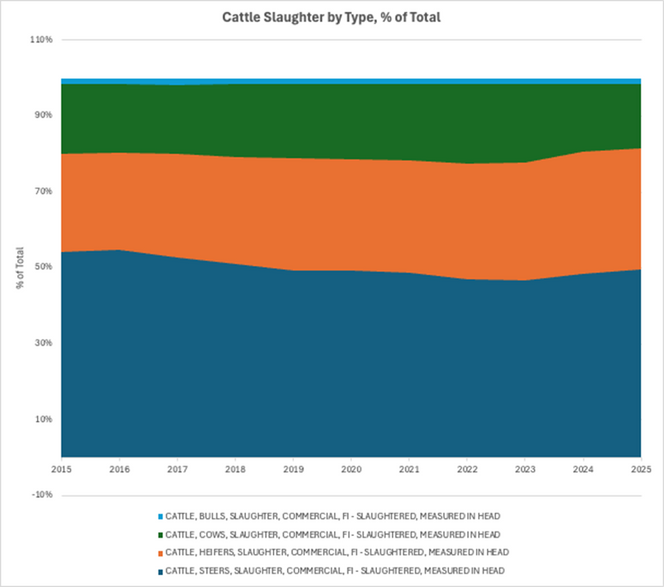
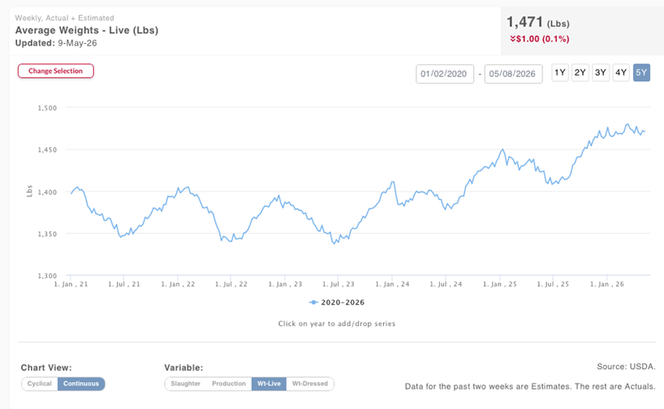
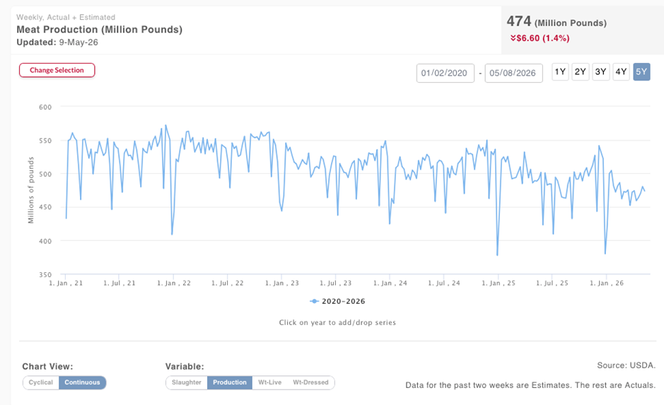
While the industry has responded to these decreases with heavier cattle (Chart 7), the increased weights have not fully offset the sharp decline in total slaughter (Chart 8).
Cattle imports
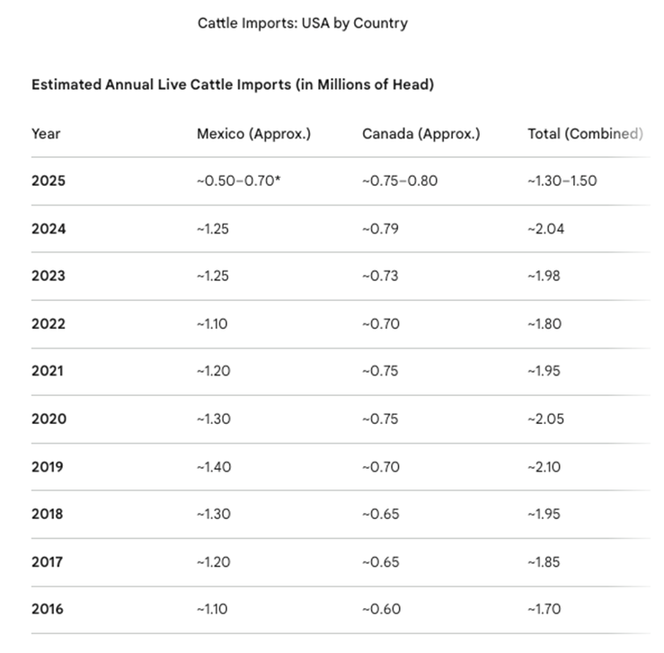
The U.S. imports live cattle, mostly from Mexico and Canada.
Imports from Mexico have been impacted since 2025, as the U.S. has imposed import restriction due to the spread of the screwworm disease in Mexico (Table 1).
This excerpt is only part of the full analysis. The complete Insights Brief includes additional historical data, market drivers, pricing trends, and key takeaways designed to help industry participants better understand the forces shaping today's beef markets.
The full report will be available soon through EMEAT.
If you have any questions or would like a personalized walkthrough of the platform, we’re happy to help. Our team can help you:
You can contact us anytime to schedule a demo based on your availability.
Or, if you're not yet a user:
Create Your Free EMEAT Account and Start Exploring Today
The meat market moves quickly. Stay informed with the data, forecasts, and insights trusted by industry professionals.
Beef
Questions about this Article?:

The EMEAT Team
Sales, Purchasing, RiskManagement
We simplify data analysis and interpretation with user-friendly, affordable, and customizable tools. Our market data, analytics, and insights empower everyone in the North American meat industry, from ranchers, feedlot operators, and meat packers to retailers and food service companies.
Sign Up and enjoy full access to EMEAT
Complete market data, advanced analytics, forecasting and risk management tools at your fingertips for 14 days. Don't miss the opportunity to explore EMEAT's full potential!
no payment information required


Copyright © 2021-2026. All rights reserved
This website stores cookies on your computer. These cookies are used to collect information about how you interact with our website and allow us to remember you. We use this information in order to improve and customize your browsing experience and for analytics and metrics about our visitors on this website. To find out more about the cookies we use, see ourPrivacy Policy.