
EN
Follow us on
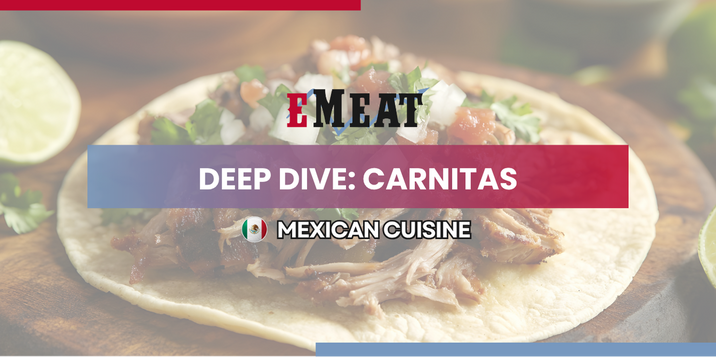
The Art and Science of the Mexican Confit
Carnitas, which translates to "little meats," originated in the state of Michoacán, Mexico.
The Spanish Influence: The dish was born shortly after the conquest, as the Spanish brought pigs and, crucially, the technique of rendering lard in large copper cauldrons.
Michoacán's Claim: To this day, the town of Quiroga is considered the world capital of Carnitas. The traditional method has remained virtually unchanged for centuries, relying on simple ingredients and specialized hardware.
The hallmark of great Carnitas is the dual texture: a succulent, tender interior and a crisp, caramelized exterior.
Tacos: Usually served on corn tortillas with "the works"—cilantro, diced white onion, and a squeeze of lime.
Mixed Cuts: Connoisseurs often order specific parts: maciza (lean shoulder), cuerito (skin/rind), or buche (stomach).
Tortas Ahogadas: In Guadalajara, carnitas are the soul of the "drowned sandwich," served on sourdough bread and submerged in a spicy tomato-chili sauce.
Carnitas is the most commercially successful Mexican pork product in the United States, viewed as the "gold standard" for pork carnivores.
Chipotle: Their Carnitas is a top-seller, though they notably transitioned to an industrial "sous-vide" method decades ago to ensure consistency across 3,000+ locations.
CPG Manufacturers:
Del Real Foods: Their "Slow-Cooked Carnitas" is arguably the most successful refrigerated Mexican meat product in U.S. retail (Costco/Walmart).
Hormel: Offers a "pre-shredded" version under their Lloyd's or specialty Mexican labels.
Restaurant Chains: Almost every Mexican-inspired chain, from Qdoba to Baja Fresh, carries a version of Carnitas, though the "crispiness" factor varies wildly.
Carnitas is essentially a confit—meat submerged in fat and cooked at a temperature that allows for both tenderization and moisture retention.
Unlike water, which boils at 212°F (100°C), fat can reach much higher temperatures without evaporating. However, traditional Carnitas are cooked "low and slow" in lard at approximately 200°F to 225°F (93°C - 107°C).
Water Replacement: As the meat cooks, the water inside the muscle fibers slowly evaporates and is replaced by the surrounding lard. This results in a product with a much higher caloric density but a significantly richer mouthfeel.
The Copper Factor: Artisans use large copper peroles (vats). Copper is an elite thermal conductor, ensuring that "hot spots" are minimized, which prevents the sugar-heavy additives (like orange juice or coke) from burning at the bottom.
Toward the end of the process, the temperature of the lard is often raised.
Reducing Sugars: Traditional recipes include evaporated milk, orange juice, or cane cola. The lactose and fructose in these ingredients undergo the Maillard reaction and caramelization on the surface of the meat.
Surface Tension: This creates the "bark" or "crust" that defines high-quality Carnitas. In industrial settings, this is often the hardest stage to replicate.
The Cut: Whole hogs are broken down into large primals, ensuring a mix of lean muscle, fat, and skin.
The Process: The meat is submerged in rendered lard. Once tender, the heat is spiked to "fry" the exterior.
The Flavor: No water is added. The flavor is a pure concentration of pork fat, salt, and the subtle sweetness of the browning agents (orange/milk).
Large-scale production cannot safely or economically maintain massive open vats of boiling lard.
Sous-Vide with "Flash-Fry": Most CPG brands cook the pork in vacuum-sealed bags with a small amount of fat and flavorings. This ensures the meat is tender and safe. After the bag is opened at the restaurant or home, the meat must be "finished" on a flat-top grill or in an oven to achieve the required crispiness.
Fat Mimetics: Because shipping pure lard is heavy and expensive, industrial producers may use emulsifiers and modified food starches to help the meat retain a "fatty" mouthfeel even if the actual lard content is lower than the artisanal version.
Oxidation Control: To prevent the fat from going rancid in the package, industrial versions heavily rely on BHA/BHT or rosemary extract as antioxidants.
| FEATURE | ARTISANAL (Traditional) | INDUSTRIAL (Mass Production) |
| Cooking Medium | Pure Rendered Lard | Vacuum-sealed (Juice + Lard) |
| Hardware | Copper Perol (Vat) | Industrial Autoclave / Sous-Vide |
| Browning Agent | Milk / Orange / Cola | Caramel Color / Dextrose |
| Texture | Crunchy Crust / Juicy Interior | Uniformly Soft (requires secondary sear) |
Beef
Fabrication
Questions about this Article?:

The EMEAT Team
Sales, Purchasing, RiskManagement
We simplify data analysis and interpretation with user-friendly, affordable, and customizable tools. Our market data, analytics, and insights empower everyone in the North American meat industry, from ranchers, feedlot operators, and meat packers to retailers and food service companies.
Sign Up and enjoy full access to EMEAT
Complete market data, advanced analytics, forecasting and risk management tools at your fingertips for 14 days. Don't miss the opportunity to explore EMEAT's full potential!
no payment information required


Copyright © 2021-2026. All rights reserved
This website stores cookies on your computer. These cookies are used to collect information about how you interact with our website and allow us to remember you. We use this information in order to improve and customize your browsing experience and for analytics and metrics about our visitors on this website. To find out more about the cookies we use, see ourPrivacy Policy.