
EN
Follow us on
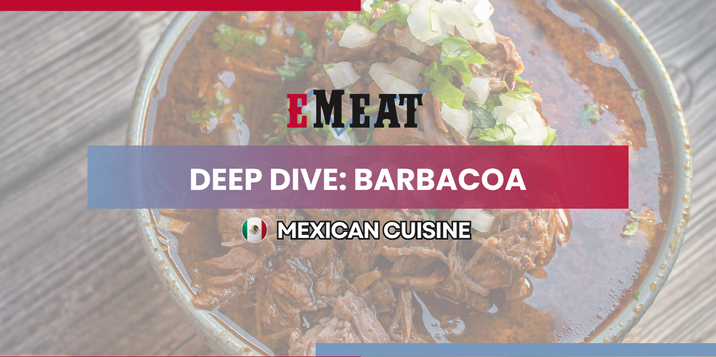
The term "Barbacoa" is the linguistic ancestor of the English word "Barbecue," derived from the Taíno word barabicu (sacred fire pit).
The Caribbean Link: Originally, it referred to a wooden grate used for smoking meat over a fire.
The Mexican Adaptation: In the central highlands of Mexico (Hidalgo and Tlaxcala), the technique evolved into a pit-steaming process.
The Species Shift: While traditionally made with mutton (adult sheep) or lamb, the dish migrated north to the U.S.-Mexico border, where beef (specifically the head) became the standard.
Barbacoa is prized for its high moisture content and "soft" texture, which differs from the "shredded" texture of Birria or the "chunk" texture of Carnitas.
The Weekend Ritual: In Mexico, it is a traditional breakfast/brunch food, often sold by weight with a side of consomé made from the drippings of the lamb.
The Taco de Cabeza: In the U.S., beef barbacoa is the star of "cheek tacos." It is served with minimal adornment—white onion, cilantro, and a sharp salsa verde to cut through the high fat content.
Mainstream Burritos: Chains like Chipotle have popularized a version made from beef brisket or shoulder, though purists argue this lacks the gelatinous mouthfeel of the head meats.
Barbacoa has the highest "mainstream" penetration of the three dishes discussed, largely due to one massive player.
Chipotle Mexican Grill: Chipotle’s use of beef barbacoa introduced tens of millions of Americans to the flavor profile (clove, bay leaf, and cumin).
CPG Manufacturers:
Del Real Foods: Their "Slow-Cooked Beef Barbacoa" is a staple in the refrigerated section of Costco and Sam's Club.
Rumba Meats: A major supplier of "specialty" cuts (cheeks, tongue), they market specifically to home cooks looking to make authentic barbacoa.
Regional Chains: Pappasito's and Cafe Rio offer "Sweet Pork" or "Beef Barbacoa" variations that lean into the tender, shredded profile.
Barbacoa is the most technically "fatty" of the Mexican slow-cooked meats, relying on specific muscle groups: the cheek (masseter) and the tongue.
Beef cheeks are among the hardest-working muscles in the animal.
Connective Tissue Density: Cheeks contain an incredibly high concentration of intramuscular collagen. Unlike the "grainy" texture of a shoulder, the masseter muscle is fine-grained but encased in thick silver skin and connective tissue.
Hydrothermal Shrinkage: During the steaming process, these collagen fibers reach their "shrinkage temperature" (around 140°F–150°F / 60°C–65°C), where they contract and expel water. However, as the temperature continues to 180°F (82°C), that collagen converts into gelatin, which then re-absorbs the rendered fat, creating a "self-basting" effect.
In artisanal production, the meat is wrapped in roasted maguey leaves.
The Set-up: A deep pit is heated with wood coals. A pot of water (containing chickpeas and rice) is placed at the bottom to catch the drippings.
The Steam: The meat is placed on a grate above the pot, wrapped in agave leaves, and buried under dirt for 8–12 hours.
The Result: The meat is steamed by the water below and its own juices, while the "soup" below becomes a rich, fatty nectar.
Scaling barbacoa requires mimicking the high-pressure steam environment without the 12-hour pit cycle.
Steam-Jacketed Kettles: Most large-scale producers use massive kettles that circulate high-pressure steam around the meat. This ensures even heat distribution and prevents the "scorching" that can happen in traditional ovens.
Enzymatic Tenderization: Since industrial processors may use leaner cuts (like neck or shoulder) to save on costs, they often use Papain (from papaya) or Bromelain (from pineapple) in a pre-tumble marinade to artificially break down surface proteins before the steam cycle.
Fat Standardization: Because beef cheeks can vary from 15% to 30% fat, industrial processors often "standardize" the batch by blending cheek meat with leaner "trim" (like 80/20 beef) to ensure a consistent nutritional label for retail.
| FEATURE | ARTISANAL (Traditional) | INDUSTRIAL (Mass Production) |
| Primary Cut | Whole Lamb / Sheep / Goat | Beef Cheek / Brisket / Shoulder |
| Heat Method | Underground Steam Pit | High-Pressure Steam Kettle / Autoclave |
| Flavor Agent | Roasted Agave Leaves | Clove, Cumin, & Liquid Aromatics |
| Consomé | Natural drippings over 12 hrs | Reconstituted Beef Base + Fat |
Beef
Fabrication
Questions about this Article?:

The EMEAT Team
Sales, Purchasing, RiskManagement
We simplify data analysis and interpretation with user-friendly, affordable, and customizable tools. Our market data, analytics, and insights empower everyone in the North American meat industry, from ranchers, feedlot operators, and meat packers to retailers and food service companies.
Sign Up and enjoy full access to EMEAT
Complete market data, advanced analytics, forecasting and risk management tools at your fingertips for 14 days. Don't miss the opportunity to explore EMEAT's full potential!
no payment information required


Copyright © 2021-2026. All rights reserved
This website stores cookies on your computer. These cookies are used to collect information about how you interact with our website and allow us to remember you. We use this information in order to improve and customize your browsing experience and for analytics and metrics about our visitors on this website. To find out more about the cookies we use, see ourPrivacy Policy.