
EN
Follow us on
The Lebanese-Mexican Fusion of the Vertical Spit
Al Pastor ("in the style of the shepherd") is the result of Lebanese immigrants moving to Puebla, Mexico, in the early 20th century.
The Ancestor: It is a direct descendant of the Shawarma. The Lebanese brought the vertical rotisserie, originally used for lamb.
The Mexican Evolution: Local cooks swapped lamb for pork (more available and popular), replaced Middle Eastern spices with dried chilies and achiote, and added the signature pineapple garnish.
The experience of Al Pastor is inseparable from the knife skills of the taquero.
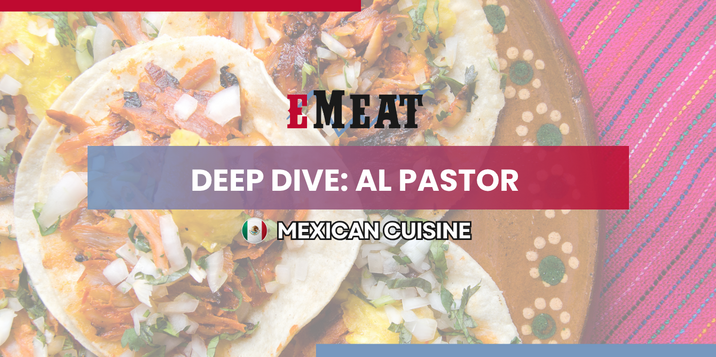
The Taco: Thinly sliced pork served on small corn tortillas.
The "Flight": A skilled taquero slices the meat from the spit and then, in one fluid motion, flicks a slice of pineapple from the top of the spit into the taco.
Gringas: A popular variation using flour tortillas and melted cheese, highlighting the meat's ability to pair with dairy.
Al Pastor is the "gold standard" for street-style tacos in the U.S., but it is technically difficult to scale for fast food.
The "Trompo" Challenge: Authentic Al Pastor requires a vertical rotisserie (trompo). Many U.S. health departments have historically been wary of vertical spits due to "middle-out" temperature concerns, though this has largely been resolved with modern equipment.
Major Chains: * Old El Paso / McCormick: Offer "Al Pastor" seasoning kits for home use.
Chipotle: Recently launched a "Pollo Asado" and "Al Pastor" chicken to capitalize on the flavor profile, though they use a flat-top grill rather than a vertical spit.
CPG: Del Real Foods and Kevin’s Natural Foods offer "Al Pastor" pork, though these are braised rather than roasted, losing the characteristic "sear."
The use of pineapple in Al Pastor is not just for flavor; it is a functional processing aid.
Enzymatic Tenderization: Pineapple contains bromelain, a protease enzyme. Bromelain works by breaking the peptide bonds in muscle proteins (myofibrils) and connective tissue (collagen).
The "Mush" Factor: Bromelain is highly aggressive. In industrial marinades, if the meat sits in pineapple juice for too long, the proteins over-denature, resulting in a mealy, unappealing texture. Artisans often use the pineapple crown atop the spit to allow the juice to slowly "drip" down, providing a controlled, continuous enzymatic tenderization during the roast.
The trompo utilizes indirect radiant heat.
External Sear vs. Internal Rest: As the outer layer of the pork reaches the Maillard reaction threshold (approx. 310°F / 154°C), the taquero slices it off. This exposes a "new" layer of marinated meat to the heat.
The "Basting" Effect: Al Pastor is stacked with layers of pork fat (back fat) between slices of lean shoulder. Gravity causes the melting fat and the pineapple juice to wash over the lower layers, a process known as self-basting, which prevents the meat from drying out despite hours of exposure to open flame.
The Build: Hand-sliced pork shoulder is marinated in an "adobo" of achiote, guajillo chilies, and vinegar. It is stacked manually onto a skewer, wider at the top to create the "toy top" (trompo) shape.
The Roast: Uses a gas-fired or charcoal vertical broiler. The taquero manages the "doneness" by rotating the spit and adjusting the distance from the flame.
For CPG and high-volume chains, the vertical spit is often too labor-intensive.
Pre-Sliced Retort: Manufacturers slice the pork and marinate it with pineapple concentrate (where the bromelain is often heat-inactivated to prevent over-tenderization) and liquid achiote.
The Flat-Top Method: Instead of roasting on a spit, the meat is flash-frozen and sent to restaurants to be cooked on a flat-top grill (plancha). To mimic the "char" of the spit, industrial marinades may include caramel color and smoke flavorings.
Enzyme Control: Industrial processors often use isolated bromelain powder in precise parts-per-million (ppm) to ensure the meat reaches a specific tenderness specification without the risk of the meat "dissolving" during the shelf-life period.
| FEATURE | ARTISANAL (Traditional) | INDUSTRIAL (Scalable) |
| Cooking Hardware | Vertical Spit (Trompo) | Flat-top Grill or Industrial Oven |
| Tenderization | Fresh Pineapple (Active Bromelain) | Inactivated Juice or Precision Enzymes |
| Fat Management | Gravity-fed self-basting | Added emulsified fats in marinade |
| Texture | Crispy "shavings" | Uniformly tender strips/chunks |
Beef
Fabrication
Questions about this Article?:

The EMEAT Team
Sales, Purchasing, RiskManagement
We simplify data analysis and interpretation with user-friendly, affordable, and customizable tools. Our market data, analytics, and insights empower everyone in the North American meat industry, from ranchers, feedlot operators, and meat packers to retailers and food service companies.
Sign Up and enjoy full access to EMEAT
Complete market data, advanced analytics, forecasting and risk management tools at your fingertips for 14 days. Don't miss the opportunity to explore EMEAT's full potential!
no payment information required


Copyright © 2021-2026. All rights reserved
This website stores cookies on your computer. These cookies are used to collect information about how you interact with our website and allow us to remember you. We use this information in order to improve and customize your browsing experience and for analytics and metrics about our visitors on this website. To find out more about the cookies we use, see ourPrivacy Policy.