
Follow us on
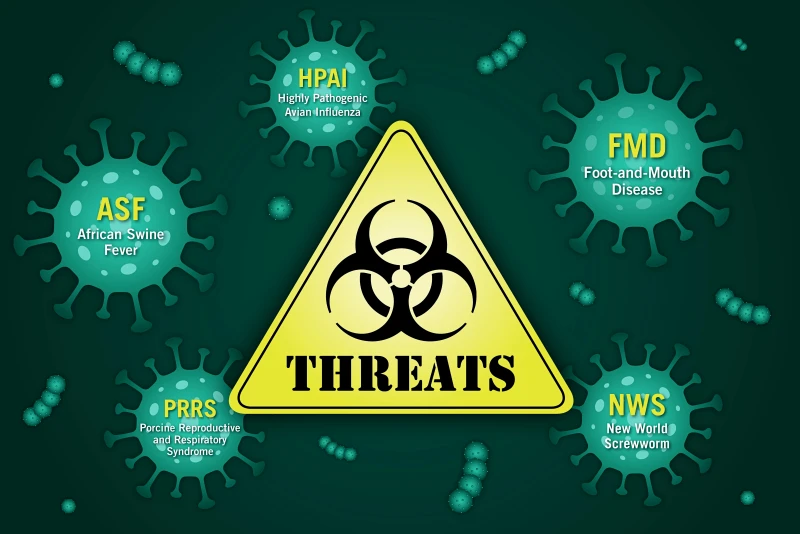
Production animal disease outbreaks are not only animal health events but threats to economic stability and food security. A new report from The Farm Journal Foundation, The Mean Sixteen: Biosecurity Threats Facing U.S. Agriculture, estimates the collective annual costs to U.S. agriculture due to outbreaks of the top five livestock diseases could top $300 billion without proper preparation.
“It is absolutely crucial that the U.S. should support mechanisms to protect farmers from risks and make sure that our food supply chain can remain resilient even when challenges occur,” wrote Stephanie Mercier, senior policy adviser at Farm Journal Foundation.
Mercier identifies five diseases with the potential to disrupt U.S. livestock production, trade and response infrastructure at scale. These include foreign animal diseases as well as ongoing threats:
- Foot-and-mouth disease (FMD)
- African swine fever (ASF)
- New World screwworm (NWS)
- Highly pathogenic avian influenza (HPAI)
- Porcine reproductive and respiratory syndrome (PRRS)
Foot-and-Mouth Disease: Trade-Stopping Risk to U.S. Livestock
Foot-and-mouth disease, an infectious and sometimes fatal viral disease affecting a range of ungulates, remains one of the highest-impact foreign animal disease threats to U.S. agriculture. While the U.S., Canada, and Mexico are classified as FMD-free, outbreaks in Taiwan (1997), the United Kingdom (2001), and this year in Germany and Hungary, represent how relevant this disease remains as both an animal health and economic threat.
Modern production systems characterized by high animal density and frequent interstate movement would complicate containment efforts in case of an outbreak. In 2015, a report from Kansas State University found an FMD outbreak beginning in a U.S. state with high populations of vulnerable livestock could cost nearly $200 billion to the U.S. economy if no emergency vaccine program was implemented.
A 2018 provision to the farm bill mandated the establishment of an animal vaccine bank; FMD was chosen as the first disease for vaccine stockpile. While FMD vaccines reduce an animal’s chance of being infected, they are generally not administerd in FMD-free regions as it is difficult to distinguish between vaccinated and FMD-infected animals in a clinical setting. Further, World Organization for Animal Health (WOAH) protocols allow for trade bans to be imposed on countries using these vaccines.
Questions about this Article?:
Copyright © 2021-2025. All rights reserved
This website stores cookies on your computer. These cookies are used to collect information about how you interact with our website and allow us to remember you. We use this information in order to improve and customize your browsing experience and for analytics and metrics about our visitors on this website. To find out more about the cookies we use, see ourPrivacy Policy.